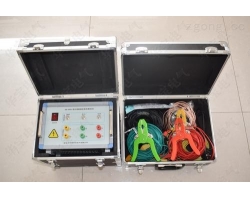

High Voltage Wireless Phase Verification Instrument: Principles and Applications
1. Introduction
The high-voltage wireless phase verification instrument is a professional tool used for phase verification and phase sequence verification in power systems. It can be used to determine the phase relationship in high-voltage lines or substations, which is crucial for the safe operation of power systems.
2. Working Principle
Transmitting Unit: The transmitting unit generates a wireless signal of a specific frequency and sends it to the point to be tested.
Receiving Unit: After receiving the signal, the receiving unit determines the phase relationship between current and voltage by comparing the phase difference between the received signal and the transmitted signal.
Wireless Communication: Utilizes wireless communication technology for signal transmission, eliminating the need for physical connections, thereby enhancing flexibility and safety in use.
3. Main Functions
Phase Verification: Determines the phase relationship between two sets of high-voltage lines.
Phase Sequence Measurement: Detects whether the phase sequence in a three-phase power system is correct.
Voltage Detection: Determines whether a line is energized.
4. Technical Features
Strong Anti-Interference: Possesses excellent anti-electromagnetic interference capability, ensuring accurate measurement even in complex electromagnetic environments.
Wireless Communication: No need for wiring or junction boxes, simplifying the installation process.
Stable Data Transmission: Adopts highly stable wireless communication technology to ensure the accuracy of measurement data.
5. Usage Method
Self-Check: Before use, ensure that the transmitter and receiver are in normal working condition.
Connection: Connect the transmitter to the line or equipment to be tested.
Transmit Signal: The transmitter generates a wireless signal.
Receive and Analyze: After receiving the signal, the receiver automatically analyzes the phase relationship and displays the result.
Record Data: Record the phase verification results, and take photos or print if necessary.
6. Application Scenarios
Power Lines: Used for phase verification during the construction of new lines or the renovation of old lines.
Substations: Perform phase verification and phase sequence verification in substations to ensure correct connection of each line.
Fault Troubleshooting: Helps quickly locate phase errors during power system fault troubleshooting.
Daily Maintenance: As part of routine maintenance of power systems, regularly check phase relationships.
7. Safety and Maintenance
Operational Safety: Follow the manufacturer's operating instructions to ensure all operations are conducted under safe conditions.
Regular Calibration: Regularly calibrate the equipment to ensure the accuracy of measurement results.
Environmental Adaptability: Ensure the equipment can operate normally under different environmental conditions.
8. Conclusion
The high-voltage wireless phase verification instrument, with its convenient operation, reliable performance, and wide applicability, plays an important role in phase verification and phase sequence verification in the power industry, and is an indispensable tool in the maintenance and construction of power systems.
The above content provides a comprehensive overview of the high-voltage wireless phase verification instrument. If you need more detailed information or in-depth discussion on specific aspects, please let me know.