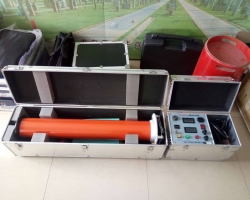
DC High Voltage Generator Referred to as Direct High Voltage Generator
DC high voltage generator, referred to as direct high voltage generator, also known ashigh voltage generator, medium frequency direct current high voltage generator, high voltage DC generator, DC generator, portable DC high voltage generator, high frequency DC high voltage generator, AC/DC high voltage generator.
Relevant national standards referenced by DC high voltage generator:
IEC 60-1: 1989 High-voltage test techniques - Part 1: General test requirements
DLT 848.1-2004General technical conditions for high voltage test devices Part 1, DC high voltage generator
The DC high voltage generator adopts a medium frequency voltage doubling circuit. The new DC high voltage generator applies PWM pulse width modulation technology and high-power IGBT devices. Based on electromagnetic compatibility theory, special shielding, isolation, and grounding measures are adopted. This enables high-quality, portable DC high voltage testing that can withstand rated voltage discharge without damage. The DC high voltage generator has multiple protection functions, such as: low-voltage overcurrent, low-voltage overvoltage, high-voltage overcurrent, high-voltage overvoltage, zero position protection, and non-grounding protection. The drive signal fast shutdown protection uses a dedicated sensor at the output end for sampling, with a response time at the nanosecond level. Through nanosecond-level optical isolation elements and nanosecond-level analog switches, the drive signal of the power amplifier circuit is cut off within 2 microseconds, ensuring that power devices are not damaged in the event of an output short circuit. It refers to a high-voltage power supply mainly used in insulation and leakage detection. There is no strict distinction between high-voltage power supplies and high-voltage generators. The DC high voltage generator is the first in the industry to adopt a sectional structure, which can be used for both high voltage levels and lower voltage levels while maintaining accuracy. Taking 100/200kV/2mA divided into two sections as an example, when used as a single section, it can be used as 100kV/2mA for DC high voltage testing of electrical equipment in systems up to 35kV, ensuring measurement accuracy and avoiding overkill; when used as two sections, it can be used as 200kV/2mA for DC testing of zinc oxide arresters at 220kV sectional, 110kV and below, and DC withstand voltage testing of cross-linked cables. It truly achieves dual use of one machine, greatly facilitating on-site users. It is mainly used to study the insulation strength of electrical equipment under DC high voltage, the insulation strength of converter station equipment and insulating materials under DC high voltage, corona and ion flow of DC transmission lines and their effects, and to conduct leakage current tests on AC and DC power equipment. In addition, it can also serve as a power source for other high-voltage test equipment such as impulse voltage generators, impulse current generators, and oscillating circuits. In other scientific and technological fields, such as physics (accelerators, electron microscopes, etc.), electronic medical equipment (X-rays), industrial applications (exhaust gas precipitation, electrostatic painting, etc.), or electronic communications (television, broadcasting stations), it is also widely used.