Product Detailed Introduction
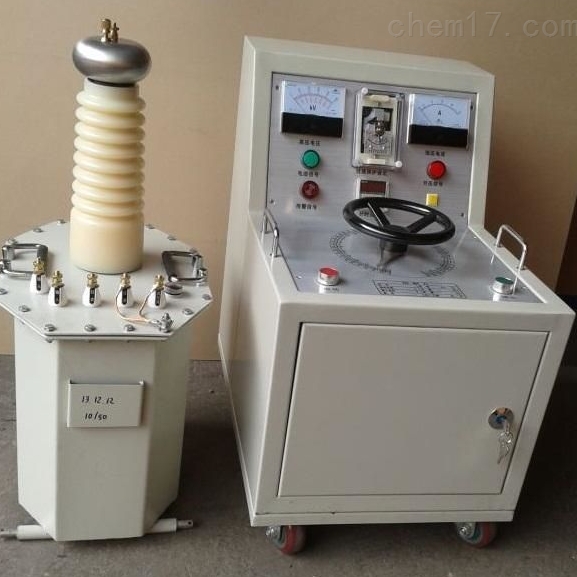
10KVA/50KV/0.2KV High Voltage Test Transformer Power Frequency Withstand Voltage Tester
I. Product Overview
10KVA/50KV High Voltage Test TransformerThe test transformer, also known as a step-up transformer, this series of products features small size, light weight, compact structure, complete functions, and convenient use. It is suitable for power, industrial, mining, scientific research and other departments, for power frequency withstand voltage tests and DC leakage tests on various high-voltage electrical equipment, electrical components, and insulating materials. It is an indispensable instrument in high-voltage testing.
II. Product Structure
YD series light high-voltage test transformer has a single-frame core. The coil adopts a coaxial cylindrical multi-layer tower structure. The primary low-voltage winding is wound on the core, and the secondary high-voltage winding is wound outside the low-voltage winding. This coaxial arrangement reduces the coupling loss between windings. The product shell is made into an octagonal structure that fits well with the core, and the overall appearance is beautiful and generous. Transformers above 10KVA are equipped with movable nylon wheels.
YDJ-10KVA/50KV/0.2KV High Voltage Test Transformer Power Frequency Withstand Voltage Tester
III. Working Principle
YD series light high-voltage test transformer is a single-phase transformer. The working process of a single high-voltage test transformer uses AC 220V (above 10KVA is 400V) voltage connected to the power control box (cabinet), through the auto-transformer inside the power control box (cabinet), adjust 0~200V or 0-400V voltage to the primary winding of the test transformer. According to the principle of electromagnetic induction, the required high voltage for the test can be obtained on the high-voltage winding of the test transformer.
IV. YDJZ AC/DC dual-purpose high-voltage test transformer for DC withstand voltage and leakage test wiring method is shown in Figure 5. Since it is an AC/DC dual-purpose high-voltage test transformer, the high-voltage silicon stack short-circuit rod should be pulled out from the bushing to make the test transformer in DC output state. Before conducting the DC leakage test, first select the resistance value of the current-limiting resistor (water resistor) according to the condition that the output short-circuit current during the leakage test does not exceed the maximum rectification of the high-voltage silicon stack, and then select the capacitance value of the high-voltage filter capacitor according to the requirements of the DC high-voltage waveform for the test object. In order to improve the measurement accuracy of the voltage applied to the test object, an FRC resistive-capacitive voltage divider should be connected on the high-voltage side to measure the voltage.
Precautions during DC leakage test operation
(1) Test personnel should divide responsibilities, set the safety distance of the test site, carefully check the grounding of the test object and the test transformer, and assign dedicated personnel to monitor safety and observe the status of the test object.
(2) Before testing the test object, all external connections should be removed, and fully discharged. The main parts should be cleaned and kept dry to avoid damaging the test object and causing errors in test values.
(3) For large-capacity test objects (capacitors, ultra-long cables, etc.), the voltage should be raised slowly during the test to prevent the charging current of the test object from being too large and burning out the microammeter. If necessary, the voltage should be raised in stages and the stable readings of the microammeter at each voltage level should be recorded separately.
(4) During the test, the test object, microammeter, and test device should be closely monitored. Once phenomena such as flashing, breakdown, etc. occur, the voltage should be immediately reduced, the power cut off, and the cause investigated.
V. Usage Methods and Precautions
2, Precautions during power frequency withstand voltage test operation
1), Test personnel should divide responsibilities, set the safety distance of the test site, carefully check the grounding of the test object and the test transformer, and assign dedicated personnel to monitor safety and observe the status of the test object.
2), The main parts of the test object should be cleaned and kept dry to avoid damaging the test object and causing errors in test values.
3), For tests on large equipment, generally a no-load test of the test transformer should be conducted first, that is, raising the voltage to the test voltage without connecting the test object.
4), During the withstand voltage test, the voltage raising speed should not be too fast, and sudden pressurization should be prevented, such as sudden closing when the voltage regulator is not at zero position, and sudden power off should also be prevented. Generally, the switch should be opened after the voltage regulator is reduced to zero position.
5), During the voltage raising or withstand voltage test, if the following abnormal conditions are found, such as the voltage and current meter pointers swinging greatly, the test object making abnormal sounds, or insulation showing signs of burning or smoking, the voltage should be immediately reduced, the power cut off, the test stopped, and the cause investigated.
3, When using this product for high-voltage tests, in addition to being familiar with this manual, national standards and operating procedures must be strictly implemented.