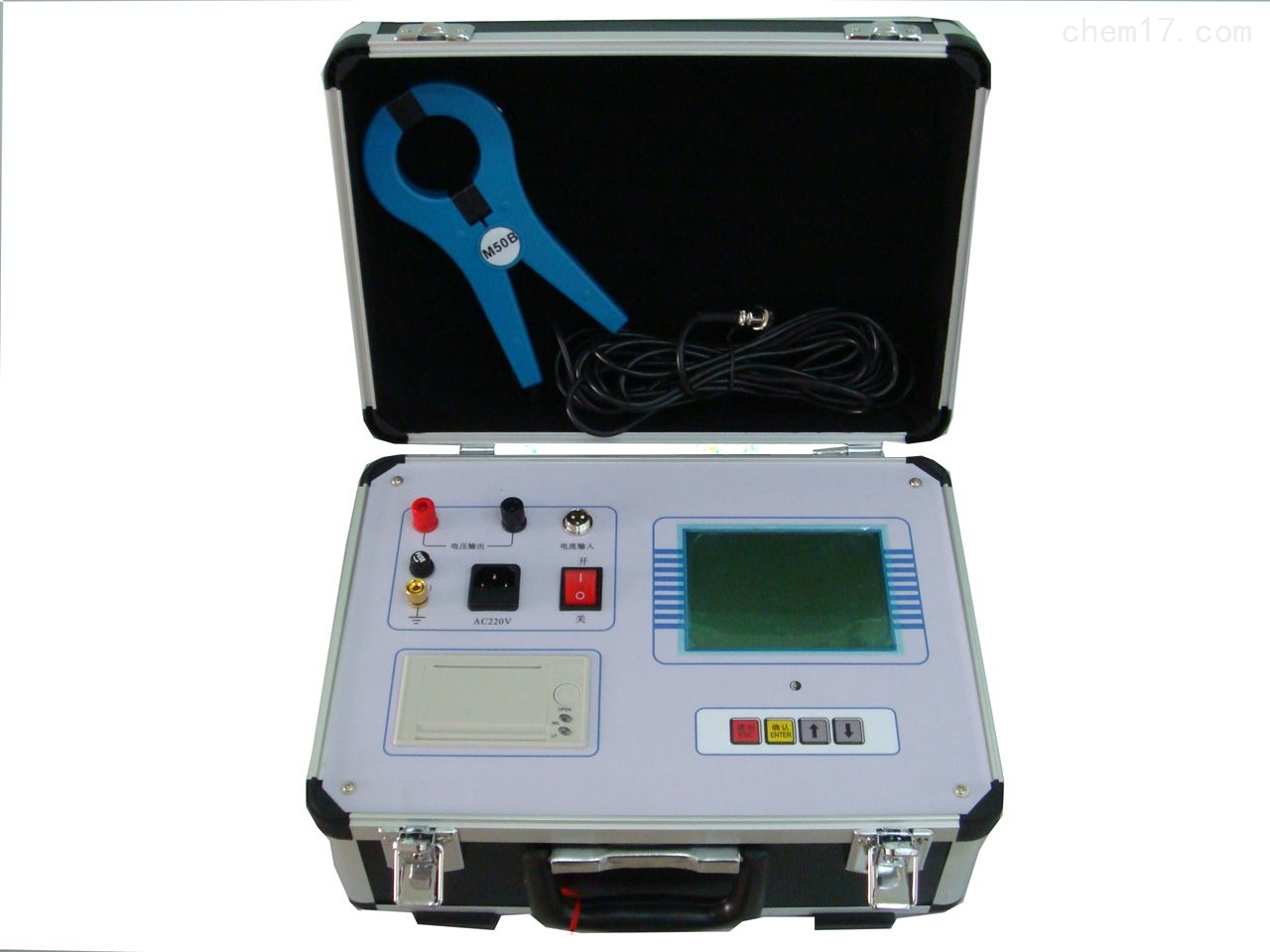
After the three-phase capacitance and inductance tester for maintenance class 1 power facilities is converted into digital signals by the A/D converter, the signals are sent to the CPU through isolation devices. The current of the capacitor under test Cx is sampled by the clamp-type CT and amplified by the program-controlled amplifier, then converted into digital signals by the A/D converter and sent to the CPU. The CPU processes the received digital signals, obtains the voltage U and the capacitor current Ic, and then calculates the capacitance according to: Cx=Ic/ωU, where ω=2πf, and f is the frequency.
Working Principle:
The transformer outputs a test voltage of 30V or 2V, which is connected to the two busbars of the capacitor bank through test leads. The busbar voltage is also introduced into the internal voltage detection circuit of the instrument through the test leads. After being converted into digital signals by the A/D converter, the signals are sent to the CPU through isolation devices. The current of the capacitor under test Cx is sampled by the clamp-type CT and amplified by the program-controlled amplifier, then converted into digital signals by the A/D converter and sent to the CPU. The CPU processes the received digital signals, obtains the voltage U and the capacitor current Ic, and then calculates the capacitance according to: Cx=Ic/ωU, where ω=2πf, and f is the frequency.
Product Introduction:
The instrument internally synthesizes a three-phase AC test source digitally, allowing direct measurement of single-phase capacitance of parallel capacitor banks or three-phase capacitors of various connection types without disconnecting wires. It can also measure the inductance of various reactors. With simple wiring and convenient testing and recording, it greatly improves work efficiency. It features a large-screen color LCD as the display window, menu operation with Chinese prompts, and a multi-parameter display interface. The user-friendly interface makes it easy and quick to use, making it the preferred product for power users at all levels.
Instrument Operation:
1. Measuring Capacitors
Connect one end of the test voltage cable to the "Voltage Output" 30V terminal, and the cable clamps at the other end to the connecting busbars of the two poles of the capacitor bank under test (as shown in the right figure);
2. Plug the test current signal cable into the "Current Input" input plug, and connect the other end to the clamp meter. Pay attention to the direction of the clamp meter's jaws. As shown in the right figure, the red clip of the voltage line and the front panel (with display) of the clamp ammeter are of the same polarity. If reversed, the sign of the phase angle between voltage and current will be incorrect, and the instrument cannot correctly identify whether the test object is capacitive or inductive;
Turn on the instrument power switch, and the display shows:
3. Turn on the instrument power switch, and the display shows:
4. Use the "Shift" key in combination; the screen cycles through: Auto Discrimination, Capacitive Test Object, Inductive Test Object, Resistive Test Object to set the test object type. Normally, the default mode is Auto. The instrument determines the test object type based on the phase difference between the test voltage and current. In some cases, if the capacitance of the test object is too small (below the instrument's measurement lower limit), the instrument can accurately read the effective current value but cannot measure the phase angle, making it impossible to determine the test object type. In such cases, the user needs to manually set the test object type;
5. After setting the "Test Object Type", press the "OK" key to enter testing.
The instrument collects voltage and current signals in real time, automatically calculates and displays the effective voltage value, effective current value, voltage frequency, and the phase angle between voltage and current (a plus sign indicates current leads voltage, meaning a capacitive test object; a minus sign indicates current lags voltage, meaning an inductive test object). After multiple data acquisitions, the instrument automatically calculates the results.
Based on the phase angle between voltage and current, the instrument determines if the test object is capacitive and calculates the capacitance (in μF) and impedance (capacitive reactance for capacitors, inductive reactance for inductors).
6. Press the "Print" key, and the instrument prints the test results.
Product Features:
1. Built-in battery, automatically digitally synthesizes a three-phase high-power test power supply, usable without external power;
2. Can measure individual single-phase capacitance of parallel capacitor banks and simultaneously measure three-phase capacitors of various connection types without disconnecting wires;
3. Can measure three phases simultaneously or measure three parallel capacitors or reactors at the same time;
4. Can measure the inductance of various reactors;
5. Can measure the amplitude of power frequency current and the harmonic content of the 2nd to 32nd harmonics in the current;
6. Can display data such as voltage, current, power, phase angle, impedance, etc., measured during the testing of capacitors or reactors for better analysis of problems;
7. Overcurrent protection for the test power supply: short circuit of the power output will not damage the instrument.
8. Uses an 800×480 large-screen high-brightness true-color LCD display, clearly visible even in sunlight;
9. Graphical menu, all-Chinese operation prompts, user-friendly interface, and easy operation;
10. Conductive silicone rubber touch keys make operation easier and extend key life.
11. Built-in large-capacity non-volatile memory: can store 200 sets of measurement data;
12. Built-in high-precision real-time clock function: can calibrate date and time;
13. Built-in high-speed micro thermal printer: users can print test data anytime via the micro printer;