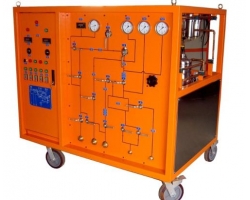

electrical equipment testing and scientific research. By utilizing the resonance characteristics of series circuits at specific frequencies, it can achieve high voltage and high current output, thus being used for withstand voltage tests and insulation performance tests of various high-voltage electrical equipment. This article will introduce in detail the working principle, structural characteristics, application fields, and usage precautions of series resonant devices.
Working Principle
The basic working principle of series resonant devices is based on the resonance phenomenon of series circuits. When the inductance (L) and capacitance (C) elements in the circuit resonate at a specific frequency, the total impedance of the circuit reaches its minimum value, and the current in the circuit reaches its maximum value. This specific frequency is called the resonant frequency (f0), and its calculation formula is:
In the resonant state, the voltage and current in the circuit are in phase, and the voltages across the inductor and capacitor are much higher than the power supply voltage, thus enabling high voltage output at lower input power.
Structural Characteristics
Variable frequency power supply: Provides an AC power supply with adjustable frequency, usually using inverter technology.
Excitation transformer: Raises the output voltage of the variable frequency power supply to the required test voltage.
Resonant reactor: Connected in series with the device under test (usually a capacitor or cable) to form a resonant circuit.
Voltage divider: Used to measure the test voltage, ensuring the safety and accuracy of the test process.
Protection devices: Including overvoltage protection, overcurrent protection, short-circuit protection, etc., to ensure the safety of the test process.
Control system: Including computer control unit and human-machine interface, realizing automated testing and data recording.
Application Fields
Power industry: Used for withstand voltage tests and insulation performance tests of high-voltage cables, transformers, circuit breakers, and other equipment in power systems.
Manufacturing: Used for withstand voltage tests of electrical equipment inside factories to ensure product quality.
Research institutions: Used for electrical performance research and new technology development, verifying the performance of new designs.
Education and training: Used for teaching and training in electrical engineering majors, helping students understand the working principles and testing methods of electrical equipment.
Laboratories: Used for performance testing and research of electrical equipment, providing accurate test data.
Advantages
High efficiency: Through the resonance phenomenon, high voltage output can be generated at lower input power, improving test efficiency.
Multi-function: Integrates multiple test functions, suitable for different types of electrical equipment and testing needs.
Automation: Some models have automatic control systems, realizing automated testing and improving test efficiency.
Portability: Some models are compact in design, easy to carry and use on site.
Easy operation: User-friendly interface, simple operation, suitable for field use.
Data management: Supports data recording and analysis, convenient for management and archiving.
Usage Precautions
Safety protection: During testing, be sure to follow safety operating procedures, wear necessary protective equipment, and ensure personal safety.
Equipment inspection: Before use, check the integrity and functionality of the series resonant device to ensure there is no damage or malfunction.
Correct connection: Ensure the connection between the series resonant device and the device under test is correct, avoiding short circuits or open circuits.
Environmental adaptation: Pay attention to the usage environment of the series resonant device, avoiding adverse conditions such as high temperature and humidity that may affect test results.
Professional training: Operators should receive professional training and be familiar with the operation methods and precautions of series resonant devices.
Regular calibration: To ensure the accuracy of test results, it is recommended to regularly calibrate and maintain the series resonant device.
Conclusion
Series resonant devices are important tools for ensuring the performance and reliability of electrical equipment. Through advanced testing technology and multiple functions, they can accurately evaluate the withstand voltage capability and insulation performance of electrical equipment, ensuring their safety and stability in actual operation. Correctly selecting and using series resonant devices can not only improve the safety and reliability of the system, but also effectively reduce the incidence of failures and ensure the normal operation of electrical equipment. I hope this article is helpful for you to understand and use series resonant devices.