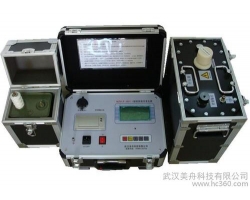

Of course. Here is an article overview of the DR-700 portable partial discharge detector
Partial Discharge (PD) is a common phenomenon in power equipment, which may lead to early aging or even failure of the equipment's insulation system. To effectively monitor and prevent such issues, the DR-700 portable partial discharge detector, as an efficient and flexible detection tool, is widely used in the maintenance and fault prevention of power systems.
Device Overview
The DR-700 portable partial discharge detector is a detection device that integrates multiple sensors, designed to provide users with a comprehensive partial discharge detection solution. It features high sensitivity, a wide testing range, and simple operation, making it suitable for on-site detection of various high-voltage power equipment.
Main Features
Multi-sensor Integration: The DR-700 is equipped with various sensors including contact ultrasonic sensors and high-frequency current transformers, suitable for different types of power equipment such as switchgear, transformers, and cables.
Intuitive User Interface: The color touchscreen design makes data reading and operation more convenient.
Intelligent Analysis Software: Built-in advanced data analysis software can automatically identify and analyze partial discharge characteristics, providing various visual analysis charts such as PRPD (Phase Resolved Partial Discharge) and PRPS (Phase Resolved Pulse Sequence).
Data Recording and Management: It can store a large amount of detection data and supports USB interface for data export, facilitating subsequent analysis and report generation.
High Portability: The lightweight design is easy to carry, suitable for on-site use.
Working Principle
The DR-700 portable partial discharge detector uses different types of sensors to capture electromagnetic waves, ultrasonic waves, or other related signals generated during partial discharge. These signals are amplified, filtered, and digitized by the built-in signal processing module, then analyzed through intelligent algorithms, and finally presented to the user in graphical or numerical form on the display.
Usage Scenarios
Power Equipment Maintenance: Suitable for partial discharge detection of power equipment such as transformers, switchgear, and cable terminations.
Preventive Maintenance: Regular testing of critical power equipment helps to identify potential issues early and avoid sudden failures.
Fault Diagnosis: When abnormal conditions occur in power equipment, the DR-700 can help technicians quickly locate the fault source and reduce downtime.
Operation Steps
Preparation: Check the device battery level and ensure all accessories are complete.
Connect Sensors: Select the appropriate sensor based on the type of equipment to be tested and install it correctly.
Signal Acquisition: Start the DR-700 and perform signal acquisition according to the device operation guide.
Data Analysis: Analyze the collected data through the built-in software to assess the degree of partial discharge.
Report Generation: Generate a detailed detection report based on the analysis results and provide maintenance recommendations.
Technical Trends
With the development of technology, portable partial discharge detectors like the DR-700 will continue to evolve towards more intelligent, integrated, and remote-capable directions. For example, by integrating more types of sensors to enhance adaptability and flexibility, and by adding wireless communication capabilities to enable remote monitoring and data transmission.
Conclusion
The DR-700 portable partial discharge detector plays an important role in the maintenance of power equipment due to its excellent performance and ease of use. Through regular partial discharge detection, it helps power companies identify equipment hazards early and ensure the stable operation of the power system.
The above is an overview of the DR-700 portable partial discharge detector. If you need more detailed information or have specific technical questions, please feel free to consult further.