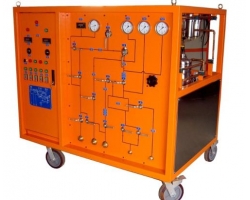

A dielectric loss tester is a specialized instrument used to detect and measure the dielectric loss of insulating materials in electrical equipment. Dielectric loss refers to the energy loss caused by polarization, relaxation, and conduction within insulating materials under an alternating electric field. This energy loss generates heat, which can affect the service life and safety performance of the equipment. Therefore, dielectric loss testing is one of the important methods for evaluating the insulation performance of electrical equipment.
Working Principle
Dielectric loss testers typically measure based on the following principles:
Current method: By measuring the leakage current of insulating materials under an alternating electric field, the dissipation factor (DF) or tanδ (tangent delta) is calculated, which is the ratio of the reactive component to the active component of the leakage current.
Bridge method: Using an AC bridge (such as a Schering bridge) to measure the impedance of the sample, thereby obtaining the dielectric loss factor.
Resonance method: By constructing an LC resonant circuit, the quality factor (Q value) of the circuit is used to indirectly measure dielectric loss.
Test Purpose
Evaluate insulation performance: Determine the dielectric loss of insulating materials at different frequencies to assess their performance in practical applications.
Fault diagnosis: By detecting changes in dielectric loss, issues such as aging and moisture in insulating materials can be identified, allowing for timely repair or replacement.
Quality control: During the production process, dielectric loss testing ensures that the quality of raw materials and finished products meets standard requirements.
Main Functions
Automatic measurement: Equipped with the function of automatically measuring the dielectric loss factor, simplifying the operation steps.
Frequency scanning: Can perform frequency scanning within a certain range to observe the trend of dielectric loss with frequency changes.
Data recording and analysis: Capable of recording measurement data and providing analysis tools to help users understand test results.
Temperature compensation: Considering the influence of temperature on dielectric loss, some advanced testers are equipped with temperature compensation functions.
Application Fields
Dielectric loss testers are widely used in the following fields:
Power systems: Testing the insulation performance of transformers, cables, motors, and other equipment.
Electronics manufacturing: Quality control of components such as PCB boards and capacitors during the production process.
Research institutions: Evaluating the dielectric properties of new materials or during the development of new products.
Aerospace: Ensuring that the insulation performance of aviation electronic equipment meets strict safety standards.
Usage Precautions
Safe operation: When using a dielectric loss tester, relevant safety operating procedures must be followed to avoid hazards such as electric shock.
Correct connection: Select the appropriate test port according to the test object and ensure correct connection.
Environmental conditions: Pay attention to temperature, humidity, and other conditions of the test environment to ensure they meet the instrument's working requirements.
Regular calibration: To ensure the accuracy of test results, the tester should be calibrated regularly.
Dielectric loss testers play an important role in the maintenance of power equipment, the development of new materials, and product quality control. By conducting regular dielectric loss tests, potential problems can be detected in a timely manner, preventing accidents and ensuring the safe and stable operation of power systems.