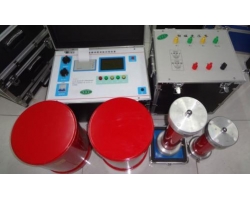

In power systems, to ensure the reliability and safety of high-voltage electrical equipment, strict withstand voltage tests are required. As an advanced high-voltage testing device, the series resonance device can effectively improve testing efficiency, reduce testing costs, and ensure the accuracy of test results.
II. Working Principle and Technical Features
Working Principle
The series resonance device mainly consists of the following parts:
Power module: Provides a stable AC power supply.
Variable frequency power supply: Converts the input AC power into AC with adjustable frequency.
Inductor (L): Used to store magnetic field energy.
Capacitor (C): Connected in series with the inductor to form a resonant circuit.
Test object: The high-voltage electrical equipment to be tested.
Measurement and control system: Used to monitor the circuit status and control the testing process.
When the frequency of the AC output from the variable frequency power supply matches the natural frequency of the series circuit composed of the inductor and capacitor, the circuit enters a resonant state. At this time, the voltage across the capacitor reaches its maximum, which can be used to test the withstand voltage performance of high-voltage electrical equipment.
Technical Features
High efficiency: Only a small power supply voltage is needed to generate high voltage, saving testing costs.
High precision: By precisely controlling the power supply frequency, stable test voltage output can be achieved.
Safety: In the resonant state, the current in the circuit is relatively small, reducing safety hazards during testing.
Portability: Modern series resonance devices are compact in design, easy to transport and conduct on-site testing.
Intelligence: Equipped with automatic tuning, data recording, and analysis functions, improving testing efficiency.
III. Main Functions
Withstand voltage test: Tests the insulation performance of high-voltage electrical equipment under high voltage.
Partial discharge test: Detects partial discharge conditions of equipment under high voltage.
Parameter measurement: Measures parameters such as capacitance and inductance to evaluate equipment condition.
Fault diagnosis: Helps diagnose potential faults in equipment by analyzing test data.
IV. Application Scenarios
Series resonance devices are widely used in the following fields:
Power cables: Used to test the insulation performance of cables under high voltage.
Motors and generators: Tests the insulation strength of motors and generators.
Power transformers: Evaluates the withstand voltage capability and insulation level of transformers.
Scientific research and education: Used in laboratories to study the performance of high-voltage electrical equipment.
V. Usage Examples
For example, in a cable laying project of a power company, technicians used a series resonance device to conduct withstand voltage tests on newly laid high-voltage cables. By adjusting the power supply frequency to achieve resonance, they successfully tested the insulation performance of the cables and confirmed that the cable quality met standard requirements.
VI. Development Trends
With technological advancements, series resonance devices are developing in the following directions:
Intelligence and remote control: Integrating more intelligent analysis functions, supporting remote data collection and analysis.
Portability and integration: More compact design, higher integration, convenient for on-site testing.
Multi-functionality: In addition to withstand voltage tests, it can also perform various electrical parameter tests.
Energy saving and environmental protection: Adopting high-efficiency design to reduce energy consumption and minimize environmental impact.
VII. Conclusion
As an important tool in high-voltage electrical testing, the series resonance device has been widely applied in power systems due to its high efficiency, safety, and multi-functionality. With continuous technological progress, such devices will become more intelligent, portable, and possess stronger data processing capabilities and remote monitoring functions, providing better guarantees for the safety and efficiency of power systems.
This article provides an overview of the basic concepts, technical features, application scenarios, and future development trends of series resonance devices. The specific content can be further expanded or adjusted according to actual needs. If there are any specific requirements or topics that need further discussion, please feel free to let us know.