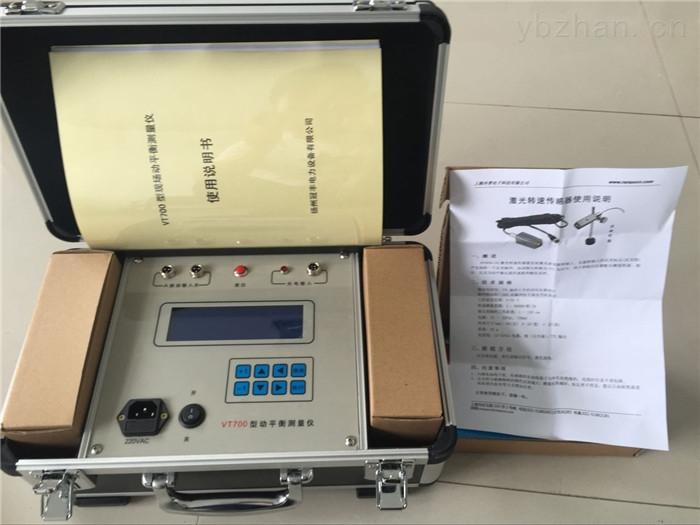
Grinding Wheel Dynamic Balancing Measuring Instrument
Product Introduction:
With the rapid development of modern industry, higher and higher requirements are placed on the performance of rotating machinery. When the mass center of rotating equipment does not coincide with the rotation center due to various reasons, vibration will be generated due to centrifugal force. This vibration seriously affects the accuracy of equipment use and shortens the life of support bearings. To eliminate this vibration, dynamic balancing technology must be used.
Aiming at the highest technology at home and abroad, it adopts large-scale integrated circuits and single-chip microcomputer technology. This instrument is multifunctional and can be used as both a tachometer and a vibration tester. It can be used for both time domain analysis and frequency domain analysis. In particular, it has all the functions for measuring dynamic balancing.
Grinding Wheel Dynamic Balancing Measuring InstrumentIt is simple to operate, with human-machine dialogue, menu prompts, and measurement data can be locked and held at any time. The VT dynamic balancing instrument is compact and lightweight, with the keyboard and display on the panel, and input/output sockets and various control switches also on the panel. It can perform on-site dynamic balancing of various rotating machinery as a whole, equivalent to a movable dynamic balancing machine. It is exquisitely designed and portable, with the entire instrument packed in a portable instrument case. In addition to general dynamic balancing functions, the PHY series also has special designs for the whole-machine dynamic balancing of horizontal screw centrifuges and disc centrifuges, increasing anti-interference capability, making it convenient to measure the vibration of composite drum bodies with differential speed and perform on-site whole-machine dynamic balancing.
Several issues that users care about in dynamic balancing measurement
3.1. Why is the trial weight method first chosen for dynamic balancing measurement?
This instrument is a portable on-site dynamic balancing instrument. Since the size and dimensions of the equipment rotor are not fixed, and the installation positions of the vibration sensor and speed sensor are also not fixed, the basic design principle of the instrument is to find the unbalanced point of the rotor by adding weights. Specifically, for single-plane measurement, two vibration measurement steps are required: one is the original vibration measurement, and the other is the vibration measurement after adding weight, to find the position of the unbalanced point. For dual-plane measurement, three vibration measurement steps are required: one original vibration measurement, and the other two are vibration measurements after adding trial weights on plane A and plane B respectively, to find the position of the unbalanced point and see the effect of dynamic balancing.
3.2. Why is it said that the influence coefficient method can save the step of adding trial weights?
For the first equipment rotor (new rotor), a set of influence coefficients must be obtained through the trial weight method. For the second equipment rotor (old rotor), under the condition that the shape, size, and structure of the new and old rotors are the same, and the sensor installation positions remain unchanged, the influence coefficients can be input for dynamic balancing, saving the step of adding trial weights, and the unbalanced point can be found after one vibration measurement.
3.3. How does the instrument convert the vibration measurement vector value into the unbalance vector value?
The vibration amplitude measured by the instrument has two units: one is the vibration velocity value expressed in mm/s, and the other is the vibration displacement value expressed in micrometers (um). The two units are selected by the "+1" key. Generally, users use micrometers: 1mm = 1000 micrometers. The phase angle of vibration only indicates the phase difference between the output signals of the vibration sensor and the speed sensor. Then the instrument requires input of the trial weight (in grams) and the position of the trial weight (in degrees). By comparing the change in vibration vectors before and after adding the trial weight, the instrument can convert the vibration vector value (micrometers and phase angle) into the unbalance vector (grams and angle). From the screen, you can see M=xxg, ФM =xx°. That is, the weight and angle of the unbalanced point, which is the set of data users care most about.
3.4. Why is there no dynamic balancing accuracy index in the technical parameters in the manual?
We only produce dynamic balancing measuring instruments. The measured objects are equipment rotors provided by users, which may be imported, domestic, or even self-made. The accuracy of various equipment rotors is different and varies greatly, so we cannot formulate a unified balancing accuracy standard. The measurement accuracy of dynamic balancing depends on the accuracy level of the equipment supporting the rotor operation. The higher the accuracy level of the equipment, the higher the measurement accuracy of dynamic balancing. The technical index in the manual is unbalance reduction rate >85%. This means that if the original residual unbalance of the equipment rotor is 10g (grams), through on-site dynamic balancing operation, 8.5 grams can be removed, and the residual unbalance can reach about 1.5g (grams). This index is also an average. For rotating equipment rotors with high precision and low interference, this index can definitely be achieved. For rotors with poor precision and high interference, it may not be achieved.
3.5. Why do the amplitude and phase angle of vibration sometimes change continuously?
In vibration signal measurement, instability of vibration value and phase angle is a common phenomenon. Vibration caused by unbalance is a periodic and regular sine wave, and the sine wave signal is very stable. However, the vibration of on-site equipment is very complex, generally mixed-frequency vibration, including various vibration signals. Only when the unbalanced vibration component accounts for more than 80% of the total mixed-frequency vibration, the amplitude and phase angle of the vibration signal are relatively stable. If the amplitude of the vibration equipment has a 10% fluctuation and the phase angle changes within 10 degrees, the vibration signal is considered stable. If the unbalanced vibration component accounts for less than 50% of the total mixed-frequency vibration, the amplitude and phase angle of the vibration signal become unstable. At this time, it is necessary to find ways to identify the source of interfering vibration signals. To find out how to diagnose equipment rotor vibration faults, you can use the "FFT Analysis" function in the "Signal Analysis" of this instrument to perform spectrum analysis on the vibration signal and analyze the various frequency components causing vibration through the spectral lines.
When the amplitude and phase angle of the vibration signal are unstable, on-site processing methods include: ① Install the vibration sensor as close as possible to the bearing housing of the equipment rotor. ② Select the bandwidth in the menu to narrowband. ③ When the vibration amplitude is very small, you can increase the instrument's amplification factor for measurement. ④ If the equipment rotor base is not fixed, fix it properly. Use rubber pads for vibration isolation.
There is a phenomenon that needs explanation: during the dynamic balancing process, when the unbalance value changes from large to small, and the vibration measurement value and phase angle change from stable to unstable, this is a normal phenomenon, indicating that the measurement accuracy of the instrument has been reached.