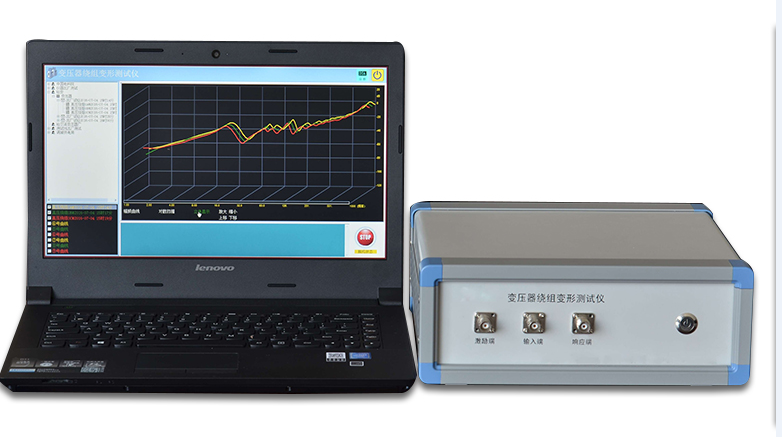
The instrument comes with a DDS signal output channel as the excitation signal for frequency sweep; the signal output is a sine wave, and the signal output amplitude can be adjusted by software, with a maximum amplitude of ±5V and a signal output impedance of 50Ω
Two acquisition channels: one for acquiring the excitation signal and one for acquiring the response signal, used to calculate the transfer function
The excitation channel measurement has a fixed range: ±5V; the response channel has 8 range settings, which are automatically adjusted during measurement, with a maximum input signal of ±25V
Acquisition channel quantization accuracy: 12 bits
Maximum static error of acquisition channels: 0.5%
Maximum storage capacity per channel: 64K samples
Maximum sampling rate per channel: 20Msps
Input impedance of acquisition channels: 1MΩ
Frequency sweep measurement range: 1K-1MHz
Sweep mode: linear distribution frequency sweep measurement
Sweep frequency accuracy: the frequency accuracy of the sine signal output by the signal source is not greater than 0.01%
Sweep measurement points: 1K-1MHz, 1000 measurement points
Uses Vittal original chassis
Complies with national electric power industry standard: DL/T911-2004
Winding Deformation TesterUsage Features
1. The transformer winding deformation tester consists of a measurement part and an analysis software part. The measurement part is controlled by a high-speed microcontroller, composed of signal generation and signal measurement. The analysis part is completed by a laptop. The measurement part is connected to the laptop via a USB universal interface, plug-and-play, and easy to use.
2. During the test, only the connecting busbars of the transformer need to be removed; all tests can be completed without lifting the transformer cover or disassembling it.
3. The instrument has dual-system measurement functions of linear frequency sweep and segmented frequency sweep, compatible with the current two technical schools of measurement modes in China. The linear frequency sweep has a scanning frequency up to 2MHz, providing more analysis for transformer deformation.
4. The instrument is highly intelligent and easy to use, with functions such as automatic range adjustment and automatic sampling frequency adjustment.
5. The software uses the Windows platform, compatible with Windows 98/2000/winXP.
6. Provides historical curve comparison analysis, can load multiple historical curves for observation simultaneously, and can select any frequency band for amplification for horizontal and vertical analysis. Equipped with an expert intelligent analysis and diagnosis system, it can automatically diagnose the state of transformer windings, load up to 6 curves simultaneously, automatically calculate the relevant parameters of each curve, automatically diagnose the deformation of windings, and give diagnostic reference conclusions.
7. The software has powerful management functions, fully considering the needs of on-site use, automatically saving environmental condition parameters to provide a basis for transformer winding deformation diagnosis. Measurement data is automatically saved, and it has color printing function, convenient for users to generate test reports.
8. The software is highly user-friendly; most measurement conditions are options. Detailed transformer parameters can be saved for diagnostic reference, and they do not need to be entered on-site; information can be added or modified later, making it more convenient to use.
9. The software is highly intelligent. After connecting the input and output signals and setting the condition parameters, all measurement work can be completed, and historical waveform curves can be opened for comparison and observation or to stop measurement at any time during measurement.
10. The time required for each phase measurement is less than 60 seconds. For a power transformer with high, medium, and low windings (capacity and voltage level unlimited), the total time for winding deformation measurement does not exceed 10 minutes.
11. When measuring transformers, wiring personnel can arbitrarily place signal input and output leads without affecting the measurement results. They can stay on the transformer oil tank without coming down, reducing labor intensity.