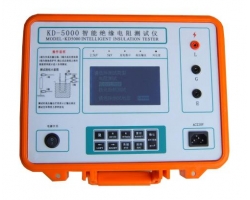

Digital Insulation Resistance Tester Polarization Index (PI) and Absorption Ratio (DAR)
7.1 Functions of Polarization Index (PI) and Absorption Ratio (DAR):
The Polarization Index (PI) and Absorption Ratio (DAR) are tests to check whether the leakage current of an insulator increases over time. It confirms that the leakage current does not increase with the application time. The instrument automatically calculates the polarization index PI and absorption ratio DAR values. The digital insulation resistance tester uses these as criteria to judge insulation performance. Both PI and DAR indicate the change in insulation resistance of the tested object after a period of voltage application.
7.2 Differences between Polarization Index (PI) and Absorption Ratio (DAR):
For general insulation tests, such as enclosure insulation and tool handles, it is usually possible to test within a short time whether the leakage current increases with the applied voltage time. Therefore, a short-time test is generally sufficient. The insulation resistance ratio DAR measured in a short time is called the absorption ratio (specific test times are given in the formulas below). However, for large-capacity and long-absorption-process test objects, such as transformers, generators, cables, capacitors, and other electrical equipment, the absorption ratio (DAR) may not fully reflect the entire absorption process. The digital insulation resistance tester can use a longer-time insulation resistance ratio, i.e., the ratio of insulation resistance at 10 minutes (R10min) to that at 1 minute (R1min), PI, to describe the entire insulation absorption process. PI is called the polarization index.
PI and DAR values are calculated using the following formulas:
Note: 1: R10Min = resistance value measured after applying voltage for 10 minutes
2: R1Min = R60Sec = resistance value measured after applying voltage for 1 minute
3: R30Sec = resistance value measured after applying voltage for 30 seconds
4: R15Sec = resistance value measured after applying voltage for 15 seconds
5: The calculation time for DAR can be selected as 15 seconds or 30 seconds.
7.3 Testing Polarization Index (PI) and Absorption Ratio (DAR)
The Polarization Index (PI) and Absorption Ratio (DAR) tests can only be performed on de-energized circuits. Before testing, the digital insulation resistance tester should check whether the test leads are in good condition and confirm that the circuit under test is not live.
Turn the rotary switch to the appropriate position, then press the VSEL key to select the voltage value for testing.
Press the SET key to set the corresponding mode. The LCD lower left corner displays "10:01m" for polarization index mode, "60:15S" for absorption ratio mode with 15 seconds, "60:30S" for absorption ratio mode with 30 seconds, and no small digits for insulation resistance measurement mode.
Connect one end of the ground lead (black) to the EARTH terminal of the meter and the other end to the ground terminal of the circuit under test. Connect one end of the high-voltage probe test lead (red) to the LINE terminal of the meter and the other end (tip) to the circuit under test, then press the TEST button. The LCD displays the measured value. After the measurement, read the absorption ratio or polarization index value once the displayed value stabilizes.
7.4 Applications of Polarization Index (PI) and Absorption Ratio (DAR):
In engineering, insulation resistance and absorption ratio (or polarization index) can reflect the degree of moisture in the insulation of equipment such as generators and oil-immersed power transformers. After insulation is dampened, the absorption ratio (or polarization index) value decreases (as shown in Figure 1), making it an important indicator for judging whether insulation is damp.