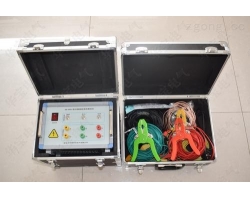

A wireless high-voltage phase verifier is a professional device used in power systems, primarily for measuring the phase relationship in high-voltage lines or substations to ensure the safe operation of the power system. Below is an overview of an article about the wireless high-voltage phase verifier:
Wireless High-Voltage Phase Verifier: Key Technology in Modern Power Systems
Introduction
In the construction and maintenance of power systems, ensuring the correctness of phases between various lines or substations is crucial. As an important technical tool, the wireless high-voltage phase verifier can perform phase comparison without interrupting power supply, which is of great significance for ensuring the safe and stable operation of the power grid.
Overview of Wireless High-Voltage Phase Verifier
The wireless high-voltage phase verifier is an advanced device that can measure phase without physical connection. It typically consists of a transmitting unit and a receiving unit. The transmitting unit is responsible for capturing the phase signal from the high-voltage line and converting it into a wireless signal for transmission; the receiving unit is responsible for receiving these signals and performing phase comparison through an internal processing unit to determine the phase relationship between lines.
Working Principle
The working principle of the wireless high-voltage phase verifier is based on electromagnetic field theory. The transmitting unit is placed on the high-voltage line under test, obtains the phase signal through inductive coupling, and then encodes and transmits the signal wirelessly. After receiving the signal, the receiving unit calculates the phase difference between the received signal and the transmitted signal to determine the phase relationship between the two.
Technical Advantages
High Safety: Since no physical connection is required, the risk to workers in high-voltage environments is reduced.
Convenience: Simple and quick installation and removal, suitable for various complex working environments.
High Reliability: Advanced wireless communication technology ensures stable and accurate data transmission.
Versatility: In addition to phase verification, it can also perform phase sequence verification, frequency measurement, and other functions.
Application Scenarios
New Construction Projects: Used to confirm phase consistency when building new substations or erecting new high-voltage lines.
Retrofit Projects: Ensures phase matching between new and old equipment during upgrades of existing power facilities.
Routine Maintenance: Regular phase calibration of power facilities to prevent accidents caused by phase errors.
Usage Method
Preparation: Confirm that the transmitting and receiving units have sufficient battery power.
Transmitting Unit Setup: Place the transmitting unit on the high-voltage line or equipment under test.
Receiving Unit Configuration: Select the appropriate number of receiving units as needed and configure them.
Signal Reception and Processing: After receiving the signal, the receiving unit processes and displays the data.
Result Analysis: Determine the phase relationship based on the displayed results, and if necessary, take appropriate measures to adjust.
Typical Products on the Market
Common wireless high-voltage phase verifiers on the market include but are not limited to:
SH32A Wireless High-Voltage Phase Verifier: Has functions such as phase verification, phase sequence testing, and voltage detection.
TAG-6000 Wireless High-Voltage Phase Verifier: Fully intelligent, wireless transmission, voice phase verification, voltage range covers 60KV to 500kV.
LZ6000 Wireless High-Voltage Phase Verifier: Also known as fully intelligent wireless high-voltage voice phase verifier, with functions such as phase verification, voltage detection, phase, frequency, and phase sequence testing.
Conclusion
With technological advancements, the wireless high-voltage phase verifier has become an indispensable tool in the power industry. It not only improves work efficiency but also significantly enhances the safety of power systems. In the future, with continuous innovation in wireless communication technology, such devices will become more intelligent and precise.
The above content summarizes the basic principles, main advantages, and application scenarios of the wireless high-voltage phase verifier. I hope this information provides you with valuable reference. If you need more detailed product parameters or specific usage cases, please let me know the specific details required.