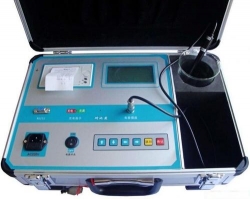

It is widely applied in the testing, maintenance, and scientific research fields of power systems. This device adjusts the values of inductance (L) and capacitance (C) to achieve a resonant state at a specific frequency, thereby effectively amplifying the input voltage to conduct high-voltage tests on electrical equipment. Below is an overview of an article about series resonant devices, aimed at helping readers understand its working principle, application areas, and development trends.
Overview of Series Resonant Devices
A series resonant device mainly consists of an inductor, a capacitor, a power supply, and a control system. When the circuit is in a resonant state, the inductor and capacitor produce a canceling effect on each other, making the entire circuit exhibit pure resistive characteristics, at which point high voltage output can be achieved. This characteristic makes series resonant devices particularly suitable for withstand voltage tests on long cables, induced withstand voltage tests on large-capacity transformers, and other occasions.
Working Principle
The working principle of a series resonant device is based on the resonant characteristics of an LC circuit. When the inductance (L) and capacitance (C) in the circuit match a certain frequency (f), that is, satisfying the formula
, the circuit enters a resonant state. At this time, the inductive reactance and capacitive reactance in the circuit are equal and cancel each other out, causing most of the input voltage to be converted into output voltage. By adjusting the values of the inductance or capacitance, the resonant frequency can be changed to adapt to different testing requirements.
Application Areas
Cable withstand voltage tests: For long cables, their capacitance effect is significant, making traditional power frequency withstand voltage tests difficult to achieve, but series resonant devices can overcome this challenge.
Transformer testing: Conduct induced withstand voltage tests on transformers to evaluate their insulation performance.
Motor testing: Conduct withstand voltage tests on high-voltage motors to ensure the reliability of their insulation systems.
Scientific research: Used in laboratories to explore the behavior characteristics of electrical equipment under high voltage.
Functional Features
High efficiency: In the resonant state, the input power is mainly used to generate high voltage, resulting in high efficiency.
Flexibility: By adjusting the values of the inductance or capacitance, the frequency of the output voltage can be flexibly changed to adapt to different testing requirements.
Safety: Due to the pure resistive characteristics of the circuit in the resonant state, the impact on the tested equipment can be effectively reduced.
Portability: Modern series resonant devices are small in size and light in weight, making them easy to transport and operate on site.
Operation and Maintenance
To ensure the accuracy and reliability of series resonant devices, operators need to pay attention to the following points:
Correctly set parameters: According to the specific requirements of the tested equipment, correctly set the values of inductance and capacitance.
Safety protection: During operation, protective equipment such as insulating gloves and insulating shoes should be worn, and ensure there are no flammable materials nearby.
Regular calibration and maintenance: Regularly calibrate the device to ensure the accuracy of measurement results, and perform necessary maintenance on the equipment.
Development Trends
With the advancement of power electronics technology, series resonant devices are developing towards intelligence and integration. Future devices will place more emphasis on user experience, provide more user-friendly interfaces, and integrate more intelligent analysis functions such as automatic fault diagnosis and remote control. In addition, with the development of new energy and renewable energy, series resonant technology may also be applied in these emerging fields to adapt to more diverse testing requirements.
Conclusion
Series resonant devices play an important role in the testing and maintenance of power equipment due to their unique advantages. By properly utilizing this technology, testing efficiency can be effectively improved, ensuring the safe and stable operation of power systems. With the continuous development of technology, series resonant devices will become more efficient and intelligent, providing strong support for the sustainable development of the power industry.
When writing an article about series resonant devices, one can delve into specific application examples in a particular field based on specific application scenarios and technical details, providing more detailed data support and technical analysis to help readers better understand and master this technology.