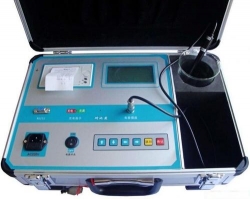

High-Precision Digital Signal Processing and Analog Output Capability of Relay Protection Testers
Of course. Here is an outline of an article about the high-precision digital signal processing capability and analog output capability in relay protection testers:
High-Precision Digital Signal Processing and Analog Output Capability of Relay Protection Testers
Abstract
This article will explore the importance of high-precision digital signal processing technology and analog output capability in relay protection testers and their application in power system relay protection testing. These features enable the tester to accurately simulate various electrical parameters in the power system, providing a reliable means for the calibration of relay protection devices.
Introduction
As a key tool in the power system to ensure the reliability of relay protection devices, the high-precision digital signal processing capability and analog output capability of relay protection testers are the foundation for accurate testing. With the increasing complexity of the power system and technological advancements, the requirements for testers are also getting higher.
Digital Signal Processing Capability
Digital signal processing (DSP) technology in relay protection testers is key to achieving high-precision testing. DSP technology includes the following aspects:
Sampling rate: A high sampling rate can capture rapidly changing electrical signals, which is crucial for simulating transient faults.
Filter design: Precise filters can remove noise interference and ensure signal purity.
Algorithm optimization: Efficient algorithms can quickly and accurately calculate the required electrical parameters, such as voltage, current, and frequency.
Real-time processing: Real-time processing capability ensures immediate feedback of test results, which is especially important for fault simulation.
Analog Output Capability
The analog output capability of relay protection testers directly relates to their ability to simulate real power systems. It mainly includes:
Voltage and current output: The tester should be able to provide voltage and current outputs over a wide range to simulate various operating conditions from low to high.
Multi-phase output: Most power systems use three-phase power supply, so the tester should have at least three-phase output capability, and some even support six-phase output.
Output accuracy: The accuracy of the output signal directly affects the accuracy of test results, typically required to reach 0.1% or even higher.
Stability: Maintaining stable output signals during long-term testing is very important for evaluating the long-term performance of relay protection devices.
Application Cases
Overcurrent protection testing: Testing the response speed and action threshold of protection devices by simulating overcurrent conditions.
Frequency anomaly testing: Simulating system frequency fluctuations to verify the frequency response capability of protection devices.
Harmonic testing: Testing the performance of devices under nonlinear load conditions by introducing specific harmonic components.
Technology Development Trends
With technological advancements, relay protection testers are moving towards higher precision, stronger functionality, and more user-friendly interfaces. For example, using advanced digital signal processors to improve sampling rate and processing speed; integrating more communication protocols to meet the needs of modern power systems; and developing more intuitive and easy-to-use software interfaces, etc.
Conclusion
The high-precision digital signal processing capability and analog output capability of relay protection testers are crucial for the safe operation of power systems. Through continuous technological innovation and improvement, these testers will continue to contribute to the safety and efficiency of the power industry.
The above is an overview of the high-precision digital signal processing capability and analog output capability in relay protection testers. If you need more detailed information or have specific application scenarios you want to learn about, please let me know, and I would be happy to help.