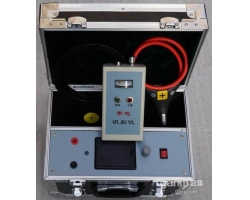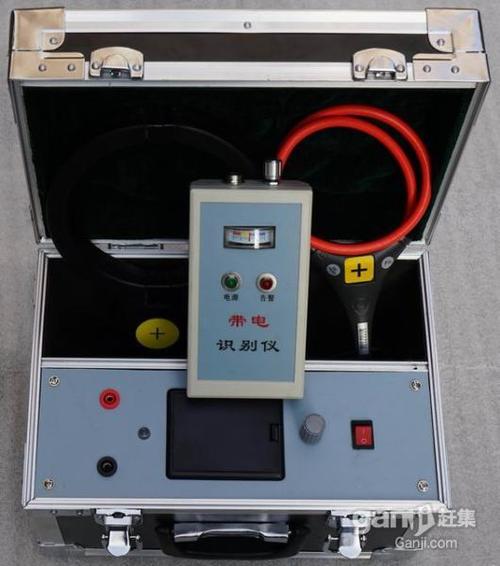
SDDL-200 Cable Identification Instrument is a specialized instrument used to identify a specific cable from a bundle of cables. It is a compact, portable instrument housed in an aluminum alloy case, consisting of a signal generator, a receiver with a clamp, and connecting wires.
II. Working Principle of Cable Identification Instrument:
To reliably and accurately identify a cable, a signal needs to be fed into the cable to be identified, which must be received by a dedicated receiver. Using this characteristic, the target cable can be identified.
The instrument works on the following principle:
The generator feeds periodic unipolar voltage pulses into the cable to be identified, which needs to be grounded at the far end to ensure sufficient current flows through the cable. The system is designed so that the return current does not flow back through the same cable. This ensures that the direction of the pulse current fed into the cable can serve as a clear identification criterion. The outgoing current passes only through this one cable, while all other adjacent cables carry the return current, but with opposite polarity. In addition to the practical difference in current direction, the current amplitude is also an identification feature. The outgoing current flows through only one cable, while the return current may flow through several cables, meaning the outgoing current is larger than the return current flowing through other cables.
The receiver's task is to detect the direction and magnitude of the current flowing through the cable. To achieve this, a current clamp is used as a sensor, which is connected in series with an amplifier. The clamp is clamped around the cable under test. The magnetic field generated by the current flowing through the cable induces a voltage in the clamp's coil. The polarity of this voltage is determined by the direction of the current and the orientation of the clamp coil. To obtain a clear voltage polarity indicating current direction, all cables in a bundle are tested with the same correct winding direction. This is why there is an arrow on the clamp. The arrow on the clamp should point towards the far end of the cable. The voltage induced in the clamp coil is displayed on the meter. If the clamp is connected as described, the direction of the pointer deflection indicates the current direction. That is, only the cable with outgoing current will cause the pointer to deflect to the right, and this is the cable to be found. All other cables only carry return current, causing the pointer to deflect to the left, or if there is no pulse current, the pointer does not deflect. The amplifier adjustment on the receiver can adjust the signal strength.
III. Application Scope and Performance Specifications of Cable Identification Instrument:
3.1 Application Scope:
The cable identification instrument is suitable for identifying the target cable among various types of cables; it is especially convenient for cables in cable trenches, cable trays, and those fixed on walls.
3.2 Performance Specifications:
Signal Generator:
Power Supply: AC220V 50Hz
Output Power: 1kVA
Output Mode: Intermittent modulation mode
Intermittent Interval: 1—2S
Ambient Temperature: -10—45 c°
Receiving Clamp and Signal Detector:
Power Supply: None
Detection Current: 5A~40A
Detection Method: Clamp-on, discriminating direction and magnitude
Clamp Opening:≥140mm, inner diameter when closed ≥120mm